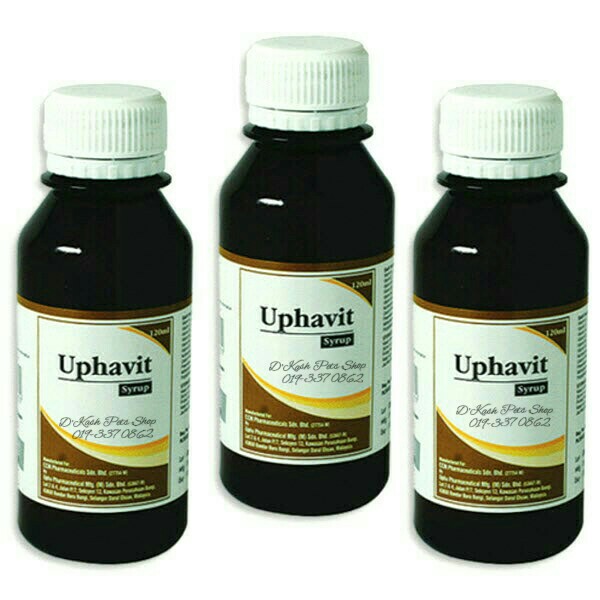
 Uphavit
Uphavit consists of Vitamin A, Vitamin B1, Vitamin B12, Vitamin B2, Vitamin B3 (Nicotinamide), Vitamin B5 (Calcium Pantothenate), Vitamin B6, Vitamin D.
Vitamin A - Retinol and derivatives of retinol that play an essential role in metabolic functioning of the retina, the growth of and differentiation of epithelial tissue, the growth of bone, reproduction, and the immune response. Dietary Uphavit (Vitamin A) is derived from a variety of carotenoids found in plants. It is enriched in the liver, egg yolks, and the fat component of dairy products.
Indication: For the treatment of Uphavit (Vitamin A) deficiency.
Uphavit (Vitamin A) is effective for the treatment of Uphavit (Vitamin A) deficiency. Uphavit (Vitamin A) refers to a group of fat-soluble substances that are structurally related to and possess the biological activity of the parent substance of the group called all-trans retinol or retinol. Uphavit (Vitamin A) plays vital roles in vision, epithelial differentiation, growth, reproduction, pattern formation during embryogenesis, bone development, hematopoiesis and brain development. It is also important for the maintenance of the proper functioning of the immune system.
Vitamin B12
Pharmacological action
Uphavit (Vitamin B12) refers to a group of water-soluble vitamins. It has high biological activity. Uphavit (Vitamin B12) is necessary for normal hematopoiesis (promotes maturation of erythrocytes). Involved in the processes of transmethylation, hydrogen transport, synthesis of methionine, nucleic acids, choline, creatine. Contributes to the accumulation in erythrocytes of compounds containing sulfhydryl groups. Has a beneficial effect on liver function and the nervous system. Activates the coagulation of blood in high doses causes an increase in the activity of thromboplastin and prothrombin.
Pharmacokinetics
After oral administration Uphavit (Vitamin B12) absorbed from the gastrointestinal tract. Metabolized in the tissues, becoming a co-enzyme form - adenosylcobalamin which is the active form of cyanocobalamin. Excreted in bile and urine.
Why is Uphavit (Vitamin B12) prescribed?
Anemia due to B12-deficiency conditions; in the complex therapy for iron and posthemorrhagic anemia; aplastic anemia caused by toxic substances and drugs; liver disease (hepatitis, cirrhosis); funicular myelosis; polyneuritis, radiculitis, neuralgia, amyotrophic lateral sclerosis; children cerebral palsy, Down syndrome, peripheral nerve injury; skin diseases (psoriasis, photodermatosis, herpetiformis dermatitis, neurodermatitis); to prevent and treat symptoms of deficiency of Uphavit (Vitamin B12) (including the application of biguanide, PASA, vitamin C in high doses); radiation sickness.
Dosage and administration
Uphavit (Vitamin B12) is used as injections SC, IV, IM, intralumbar, and also oral. With anemia associated with Uphavit (Vitamin B12) deficiency is introduced on 100-200 mcg in 2 days. In anemia with symptoms of funicular myelosis and megalocytic anemia with diseases of the nervous system - 400-500 micrograms in the first 7 days daily, then 1 time every 5-7 days. In the period of remission in the absence of events funicular myelosis maintenance dose - 100 mcg 2 times a month, in the presence of neurological symptoms - at 200-400 mcg 2-4 times a month. In acute post-hemorrhagic anemia and iron anemia by 30-100 mcg 2-3 times a week. When aplastic anemia (especially in children) - 100 micrograms before clinical improvement. When nutritional anemia in infants and preterm - 30 mcg / day during 15 days.
In diseases of the central and peripheral nervous system and neurological diseases with a pain syndrome is administered in increasing doses - 200-500 mcg, with the improvement in the state - 100 mcg / day. The course of treatment with Uphavit (Vitamin B12) is 2 weeks. In traumatic lesions of peripheral nervous system - at 200-400 mcg every other day for 40-45 days.
When hepatitis and cirrhosis - 30-60 mcg / day or 100 mg every other day for 25-40 days.
Dystrophy in young children, Down syndrome and cerebral palsy - by 15-30 mcg every other day.
When funicular myelosis, amyotrophic lateral sclerosis can be introduced into the spinal canal at 15-30 mcg, gradually increasing the dose of 200-250 micrograms.
In radiation sickness, diabetic neuropathy, sprue - by 60-100 mcg daily for 20-30 days.
When deficiency of Uphavit (Vitamin B12) to prevent - IV or IM for 1 mg 1 time a month; for treatment - IV or IM for 1 mg daily for 1-2 weeks, the maintenance dose is 1-2 mg IV or IM from 1 per week, up to 1 per month. Duration of treatment is determined individually.
Uphavit (Vitamin B12) side effects, adverse reactions
CNS: rarely - a state of arousal.
Cardiovascular system: rarely - pain in the heart, tachycardia.
Allergic reactions: rarely - urticaria.
Uphavit (Vitamin B12) contraindications
Thromboembolism, erythremia, erythrocytosis, increased sensitivity to cyanocobalamin.
Uphavit (Vitamin B12) using during pregnancy and breastfeeding
Cyanocobalamin can be used in pregnancy according to prescriptions.
Special instructions
When stenocardia should be used with caution in a single dose of Uphavit (Vitamin B12) 100 mcg. During treatment should regularly monitor the blood picture and coagulation. It is unacceptable to enter in the same syringe with cyanocobalamin solutions of thiamine and pyridoxine.
Uphavit (Vitamin B12) drug interactions
In an application of Uphavit (Vitamin B12) with hormonal contraceptives for oral administration may decrease the concentration of cyanocobalamin in plasma.
In an application with anticonvulsant drugs decreased cyanocobalamin absorption from the gut.
In an Uphavit (Vitamin B12) application with neomycin, aminosalicylic acid, colchicine, cimetidine, ranitidine, drugs potassium decreased cyanocobalamin absorption from the gut.
Cyanocobalamin may exacerbate allergic reactions caused by thiamine.
When parenteral application of chloramphenicol may decrease the hematopoietic effects of cyanocobalamin with anemia.
Pharmaceutical incompatibility
Contained in the molecule of cyanocobalamin cobalt ion contributes to the destruction of ascorbic acid, thiamine bromide, riboflavin in one solution.